Catherine Connolly Elected Ireland’s 10th President in a 63% Landslide Victory
10/25/20253 min read


The Newly Elected Deputy signing the 34th Dáil Éireann Roll Book in Leinster House, December 2024.
Catherine Connolly Elected Ireland’s 10th President in a 63% Landslide Victory
Independent TD Catherine Connolly has been elected as Ireland’s 10th president, receiving around 63% of the first-preference votes and significantly defeating Fine Gael candidate Heather Humphreys, who received 29%. This outcome represents a notable shift in the traditionally ceremonial role of the presidency, occurring amidst political unrest, low voter engagement, and a record number of spoiled ballots.
A Candidate Emerges from the Left
The 68-year-old former barrister and Galway-West TD entered the race as an outsider last summer, gaining support from left-wing parties including Sinn Féin, Labour and People Before Profit. Her platform combined social justice themes, Irish neutrality, climate action and supporters of a new republic that embraces diversity.
Speaking from Dublin Castle after her win, Catherine mapped out her vision. “I will be a voice for peace, a voice that builds on our policy of neutrality, and a voice that recognises the tremendous work being done the length and breadth of our country,” she stated. “But my message is: use your voice in every way you can.”
Turnout, Spoiled Votes and Political Undercurrents
The turnout reached 46 %—slightly higher than in 2018 but still historically low for Ireland. Notably, 213,738 votes were declared invalid or spoiled, equating to nearly 12.9 % of total ballots—an unprecedented protest display in a presidential contest.
Many political analysts view the spoiled ballots as a symptom of voter dissatisfaction with mainstream parties. Connolly’s victory came amid the collapse of Fianna Fáil’s candidate Jim Gavin, who withdrew from active campaigning yet remained on the ballot and secured 7 %.
Humphreys Concedes with Grace
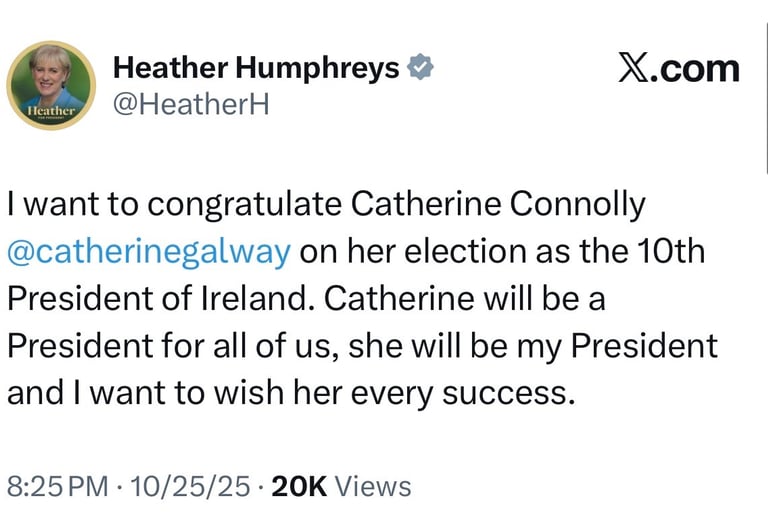
Humphreys, a former cabinet minister and rural candidate for Fine Gael, conceded early. “Catherine will be a president for all of us, and she will be my president,” she told reporters. Despite the defeat, Humphreys expressed no regrets and acknowledged the mandate she lost.
What Does It Mean to Be President in Ireland?
While the presidency in Ireland is not an executive office, the role carries symbolic weight and diplomatic significance. Historically, holders such as Mary Robinson and Michael D. Higgins have stretched the office into a visible platform for national identity and moral leadership. Connolly will take office on 11 November 2025.
Despite the ceremonial nature of the post, her election signals a departure in tone from establishment politics. Connolly’s win has been characterised by some as a rebuke to the centrist dominance of Fine Gael and Fianna Fáil.
Policy Themes: Neutrality, Social Justice and Global Outlook
Connolly’s campaign emphasised Ireland’s tradition of neutrality alongside an assertive stance on global issues. She has criticised NATO, the US, the UK and France for what she calls “militarisation”, and has advocated for greater support for Palestine and Ukraine.
Domestically, she flagged climate change, housing insecurity and economic inequality as core concerns. Irish voters facing high rents, cost-of-living pressures and sluggish infrastructure resonated with her message of change.
Immediate Challenges and Opportunities
As president-elect, Connolly will face questions about how far she will push her agenda, given the constraints of the office. Constitutional experts caution she lacks direct legislative power—but she can influence national conversation and public values.
Her left-wing credentials raise the prospect of friction with government policy, particularly around foreign affairs and Ireland’s role within the EU. Some international observers flagged concerns about her strong criticism of Western alliances.
What Comes Next?
With Connolly’s victory, attention turns to the next general election and whether this reflects a deeper political shift. Some analysts believe her win may energise younger voters and progressive parties; others caution that it remains symbolic unless cemented by broader change.
The electorate’s strong support for Connolly may also intensify pressure for reforms to the presidential nomination process itself—particularly given the large number of spoiled votes and dissatisfaction with candidate choice.
Meanwhile, Connolly inherits the role from Michael D. Higgins, who stepped down after two terms. She will assume the Áras at Phoenix Park with the mandate to serve as Ireland’s figurehead and unifier.
Reported by Orbital News
Credit: Irish Government / State relations
Connect
Connecting You to Global News
Explore
Support Orbital News
© Orbital News 2025. All rights reserved.